

Are you looking for a quick way to boost your Digital SAT Reading and Writing section score? Look no further. Learning today’s strategy will bring you excellent bang for your buck.
Take it from me: I’m Kristina Semos, the founder of Ivy Lounge Test Prep™, and my passion is working with students to make their standardized test prep way less stressful and way higher-scoring.
This post is about a very special SAT question type that I call “Meaning in Context.” They’re also known as “Words in Context.” (The ACT equivalent is Vocab in Context, which I teach you how to answer in this other post!)
I am going to explain what these questions are, how to identify them in the wild, and how to solve them in four easy steps. I’ll also demo how my approach works, step by step, with a sample question.
Ready for points galore? Let’s jump in.
ARTICLE CONTENTS
1. Watch this article as a video
2. What are Meaning in Context questions?
3. Why so many students get Meaning in Context questions wrong
4. The best way to answer Meaning in Context questions
5. What makes my method the most effective one
6. Conclusion
Watch this article as a video:
What are SAT Words in Context questions?
Before you can solve Meaning in Context questions, you’ll of course need to know how to recognize that you’re dealing with one in the first place.
Here's how the question stem will most likely be worded in this genre of Q:
As it's used in the text, the word “XYZ” most nearly means…
A. Vocab word 1
B. Vocab word 2
C. Vocab word 3
D. Vocab word 4
Now, if you’ve taken or studied for the R&W section, you might be asking: “Wait a sec. Aren't the vocabulary questions a little bit different from that format? Don’t they appear in the beginning of the test, and provide a blank space in the text, then four words as the answer choices?"
Well, those are similar—they’re Sentence Completion questions. But these Meaning in Context questions occur roughly in that same area of the Reading and Writing modules.
And where is that, exactly, you ask? I’ll show you. Here’s the structure of the Reading and Writing modules on the Digital SAT:
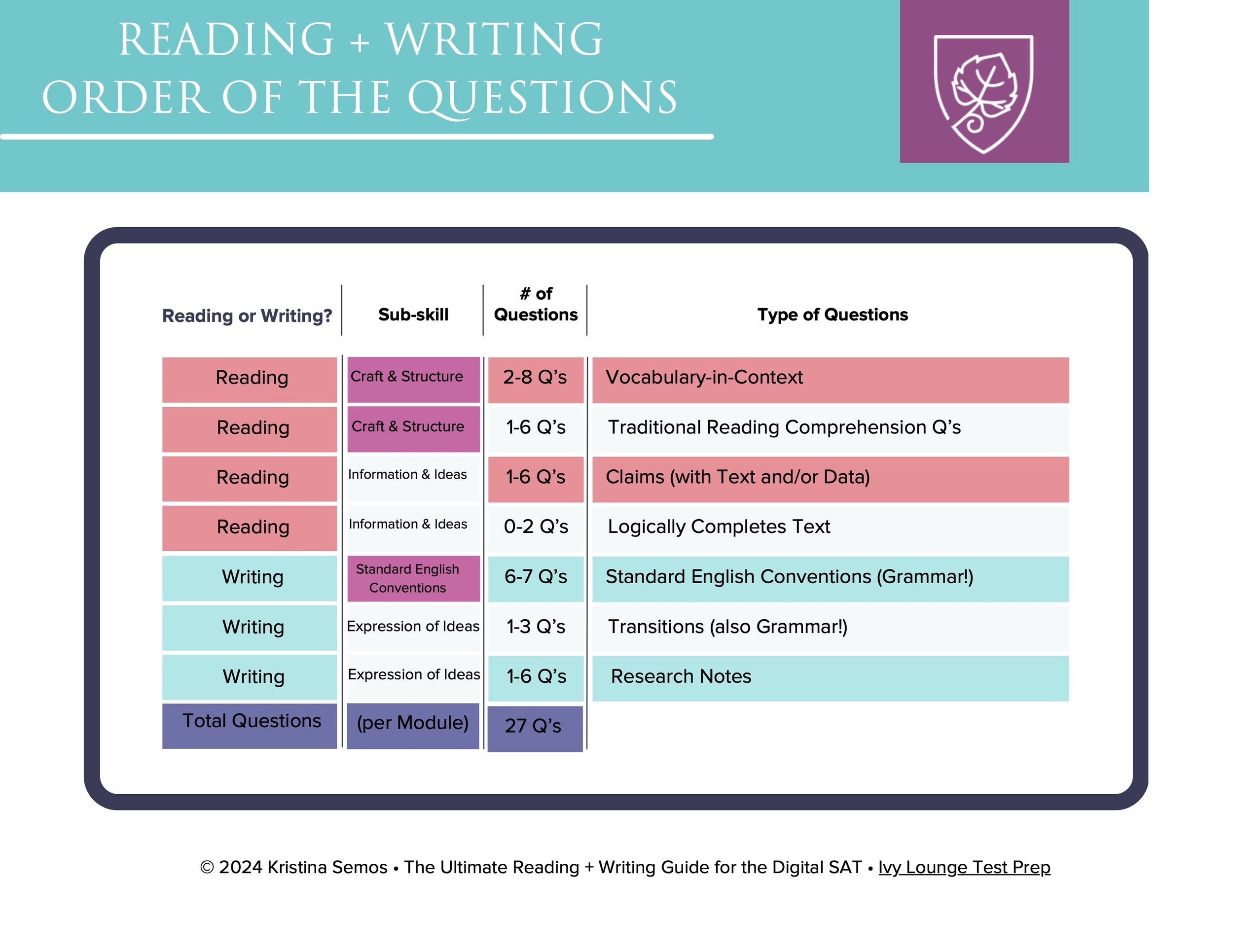
The topmost block you see on the chart—Vocabulary in Context questions—include those Sentence Completion questions, with the blanks followed by four different vocab words. Meaning in Context questions are a little bit different, but you will also find them in that very first block of questions at the beginning of either of your Reading and Writing modules.
To help you better understand what this might look like IRL, I'm going to show you a question from one of the linear (non-adaptive) practice tests that the College Board has released.
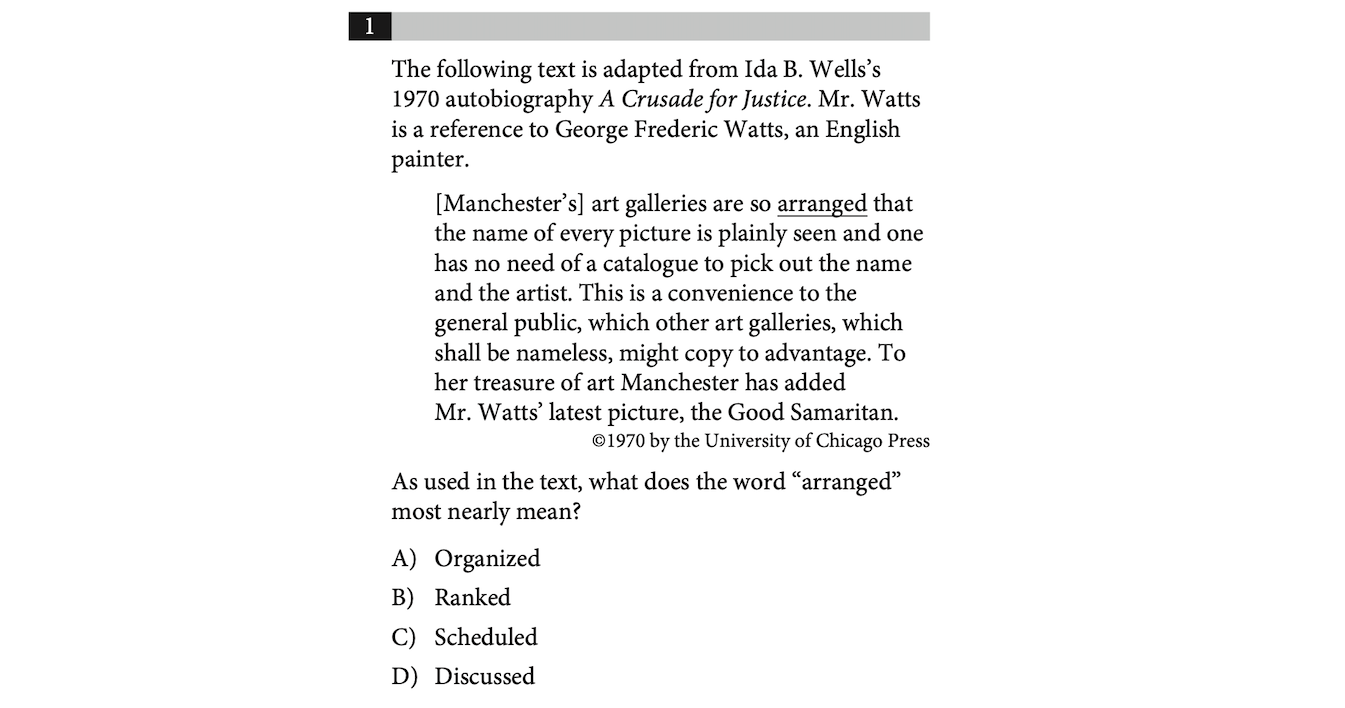
There you have it. You’re given a passage, then asked, “As used in the text, what does the word ‘arranged’ most nearly mean?” And they’ve underlined the word “arranged” in the passage.

Why so many students get Meaning in Context questions wrong on the DSAT
What’s insidious about this question type is that the instructions seem straightforward at first glance. Aren’t you just being asked to pick the answer choice that means the same word as the word they put in the quotes?
Well, kind of. When they work under this assumption, many test-takers—including a lot of my private students, before they come to work with me!—still pick the wrong answer. Why is that?
Most students figure that they should approach these questions as a simple vocabulary question, like a quiz with flashcards where there’s only one meaning to a given word, and therefore only one correct answer of the four choices.
But the question's asking something subtly different from that…because the SAT will try to bamboozle you by providing several answer choices that technically do fit some definition of the word that they’ve placed in quotes. So that's why I call these “Meaning in Context” questions (or even “Vocabulary in Context” questions) and not merely “Meaning” or “Vocab” questions.
But fear not. Because if you follow the strategy that I’ve developed for my students, then the “in context” part of the equation will take precedence, as it should—and your path to the correct answer will be very straightforward and fairly easy, if I do say so myself.
The best strategy for Vocab in Context questions on the Digital SAT
Here’s how you avoid the pitfalls of the uninformed student and answer a Meaning in Context question the Ivy Lounge Test Prep™ way. Read the passage through once, then:
1) Return to the point in the passage where the word is underlined. Read the entire sentence containing that word.
2) Reread the whole sentence that includes the word they asked you about—but this time, instead of mentally saying the underlined word, you're going to say the word “blank.”
3) Now, reread a small snippet of the sentence—enough that it includes the underlined part and you get a bit of context, but not long enough that you can't remember it. You are going to literally rattle off that snippet four times in a row, each time plugging in a different one of the answer choices instead of the underlined word.
4) Finally, you’re ready to eliminate anything that is an obvious “no.” By this point in the method, you’re usually you're left with a single answer choice, and that's the answer. Or if you have a couple answers left, then you've at least narrowed it down and can then use the context of the sentence to choose between those.

Demonstration of this strategy for R&W questions
Let's go through an example together so you can see this Digital SAT question type in action. I’ll paste in the same example from before.
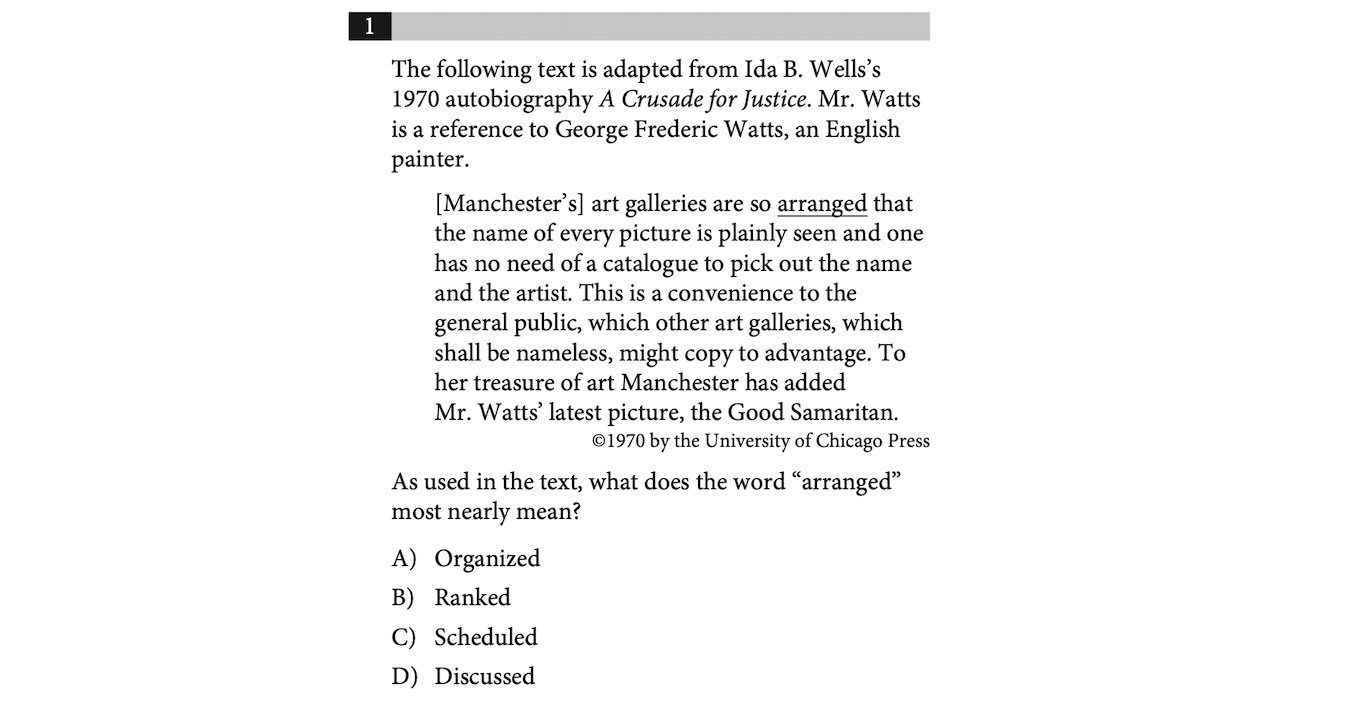
The first thing we’ll do, obviously, is to read the question stem to figure out what genre of question we’re working with. This informs us that the question is asking, “What does this word most nearly mean?” This signals to us that it's a Meaning in Context question. We then read the whole passage.
And now to put our Meaning in Context method to work:
1) We return to the sentence that has the underlined word, and we read it as-is.
[Manchester's] art galleries are so arranged that the name of every picture is plainly seen and one has no need of a catalogue to pick out the name of the artist.
2) Now we read it again with our mind’s eye, but this time we’ll insert the word “blank” for the word “arranged.”
[Manchester's] art galleries are so blank that the name of every picture is plainly seen and one has no need of a catalogue to pick out the name of the artist.
3) Pick a smaller snippet of the sentence that includes the blank and start plugging in your four answer choices in succession.
[Manchester's] art galleries are so blank.
[Manchester's] art galleries are so organized.
[Manchester's] art galleries are so ranked.
[Manchester's] art galleries are so scheduled.
[Manchester's] art galleries are so discussed.
4) As you hopefully noticed, some of those snippets—liked “art galleries are so scheduled” and “art galleries are so discussed” really don’t make sense in the context of the paragraphs. But organized and ranked are the two closest options. So I might now reread the whole sentence, plugging in organized and then plugging in ranked.
“[Manchester's] art galleries are so organized that the name of every picture is plainly seen and one has no need of a catalogue.”
That makes sense. How about:
“[Manchester's] art galleries are so ranked that the name of every picture is plainly seen and one has no need of a catalogue.”
Hmmm…nope. When I use “ranked,” the second part of the sentence does not at all logically follow from the first.
Through the process of elimination, I’ve arrived at option A (organized) as my answer. Which is, in fact, the correct answer.

Why this method is most effective
So why does my strategy for Meaning in Context questions beat any other approach out there?
To explain this, I’ll draw your attention to a few counterintuitive parts of the strategy…i.e., things that most students do NOT naturally think to do when faced with these questions.
1) Never in the process did I ask myself what the word “arranged” means. Because honestly, the word “arranged” doesn't really interest us in the abstract, right? We only care about what the word “arranged” means in that particular sentence. Hence the “Meaning in Context” label, right?
2) In the second step of the method, I reread the whole sentence containing the underlined word…BUT I used the placeholder “blank” instead of the word “arranged.” Though this might seem like a waste of time to a new student, it is actually an essential step. This process helped my brain silence any preconceived notions or definitions that I might have held for the word “arranged.” This, in turn, allowed me to remain truly neutral when I tried out the options in step 3.
3) I reread that whole snippet four different times, each one with a different answer choice plugged in. I did NOT just read it once and then say the four words all in a row, like:
“[Manchester's] art galleries are so organized, ranked, scheduled, discussed.”
Nope! I instead said internally,
“[Manchester's] art galleries are so organized.”
“[Manchester's] art galleries are so ranked.”
“[Manchester's] art galleries are so scheduled.”
“[Manchester's] art galleries are so discussed.”
I literally reread that segment four different times. If you don't do that, your ear will only really hear and understand what that first option (organized) meant when you inserted it into the blank. As for the other three, you’ve just wasted your time. Your brain isn't going to really process what they mean in that sentence.

Conclusion
I recommend practicing this strategy a few times. It’ll be worth its weight in points! I don't want you to be stumped (or waste too much time) when you encounter Meaning in Context questions on this Digital SAT.
If today’s article left you hungry for more, then there are two ways that you can get more test prep information and work with me.
1) One is to check out my tutoring packages and see if we might be a fit for one-on-one lessons. I’ll create a custom study plan that helps fill your specific content and strategy gaps…without wasting time on generic prep like a one-size-fits-all book or tutor might.
2) If you're more of a lone wolf when it comes to studying, no worries—I also offer online courses for the Digital SAT’s Reading & Writing and Math sections!

