

Recently, one of my amazing SAT tutoring clients—let’s call him Mason—arrived at our weekly session looking weighed down by worry. His concern was one that I’ve encountered many times over the past fifteen years while helping high schoolers get into the world’s top-ranked colleges: time.
Mason had the intense junior year courseload and extracurriculars list familiar to most elite applicants. Homework, practice, and rehearsal were already taking up what felt like every spare second of his day. So, he asked me, how the heck was he supposed to actually find time to study for the SAT?
Mason wasn’t used to struggling with this kind of thing. In fact, he’d been crushing test prep before fall semester midterms started. This was a bright, driven student who would never dream of going to school without his homework finished. He’d felt ashamed that he hadn't been well prepared for some of our most recent SAT prep sessions.
If he literally couldn’t find the time to sit down and study for the SAT, how could he possibly get the high score he needed for that dream school—a high score he knew he was capable of achieving, but that felt frustratingly just out of reach given his time constraints?
Perhaps you or someone you know is in a similar bind. You’re already feeling squeezed by junior spring, or senior fall, and you just don’t know how you’re going to get it all done—let alone done WELL. Fortunately, through working with thousands of students with similarly ambitious schedules, I’ve developed a simple but effective technique for solving this issue—and I’m sharing it with you today.
Article Contents
3. Look at the time that remains.
5. Conclusion
How to Find Time for SAT and ACT Test Prep
1) DRAW OUT your schedule.
The first thing Mason and I did was to grab a blank sheet of paper, divide it into seven days (Sunday through Saturday), and block off all chunks of time that were taken up by recurring activities.
This could include:
Noting the time you wake up
Blocking off the hours that you’re physically in school every Monday through Friday
Labeling the time it takes you to shower, get dressed, eat breakfast, and travel to school
Carving out time for your extracurricular activities each week
Do you eat your dinner as a family at a certain time each night? Draw that in.
Is there a certain time you need to go to bed to get your seven to nine hours? Yep—block that off, too. Excellent sleep is non-negotiable for excellent college applicants!
What about weekend commitments? Do you attend temple or church, or see your Aunt Edith for lunch every Sunday, or take sketching classes? They all get a designated slot. You get the idea.

Start here: a column for every day, with your school day serving as the basic blueprint upon which the rest of your schedule gets built.
2) Be realistic about how much time you need for schoolwork.
Thinking back over his past few weeks of schoolwork, Mason concluded that he’d given an average of two hours to homework each school night, and needed about three hours of prep time a week to study for each test. He generally had two tests per week, so we needed to fit in an extra ~six hours of study time somewhere.
If this is starting to sound like a thorny math problem, I promise, seeing it on paper makes this all seem MUCH less abstract and more doable.
It’s important to be really honest with yourself during this stage of the process rather than lowballing how much time you need to complete other commitments. If you can draw accurate conclusions now about how much time you really need to ace that AP Physics exam or get the grade you need in Spanish, you won’t be freaking out and having to reconfigure your schedule every day. Instead, you’ll get to feel calm and focused because you’ll know how much time you ACTUALLY have to do a given thing. So think realistically, and make your best guesses.
Studying for school tests is flexible—you could get studying done at various points in the day, from study hall to after soccer—so find where they fit best based on your work habits, energy levels, and daily responsibilities, and block these off, too.

Now we've filled in extracurricular commitments, recurring appointments, the needs of a daily routine, and even family time.
3) What's left? Your ACT or SAT study time!
In Mason’s case, if he really got his homework done after school but before dinner (instead of vaguely planning to work but ending up bingeing YouTube unboxing videos with his sister), he would have the post-dinner, pre-bed time slot to either study for a test in school OR study for the SAT. Nice! We’d found his standardized test prep time!
(And SAT prep wouldn’t even need that much time: 30 minutes to an hour in a given session, sure, but not 2.5 hours! There was still some YouTube time left after all. Phew!)
Another nice side effect was that we’d also located some buffer time in Mason’s schedule for those weeks when he had extra tests or projects due: all Saturday afternoon and basically all of Sunday after lunch. This time could be used to do homework, chip away at a school project, do SAT prep, study for an exam...OR, he could opt to use that time to have some fun with family or friends.
The final bonus: because he would no longer be feeling a constant, low-key anxiety about the fact that he should be prepping for the SAT instead of kicking back, "fun" times were suddenly a lot more fun! We’d discovered pockets where he could fully rest and refresh, meaning his brain would be readier to lock in when it was time to do so.
Here's the bottom line: Mason now knows that the way he spends his time is his choice, and he can make it an informed choice. He knows when those time slots are that he can use to work or study. If he has fewer commitments on his plate in a given week, he can YouTube away! But if he has a particularly hectic week on the books, he knows what to focus on in his schedule so he doesn’t waste his opportunities to accomplish what he wants. It helped him feel calmer and get more done—the best of both worlds.
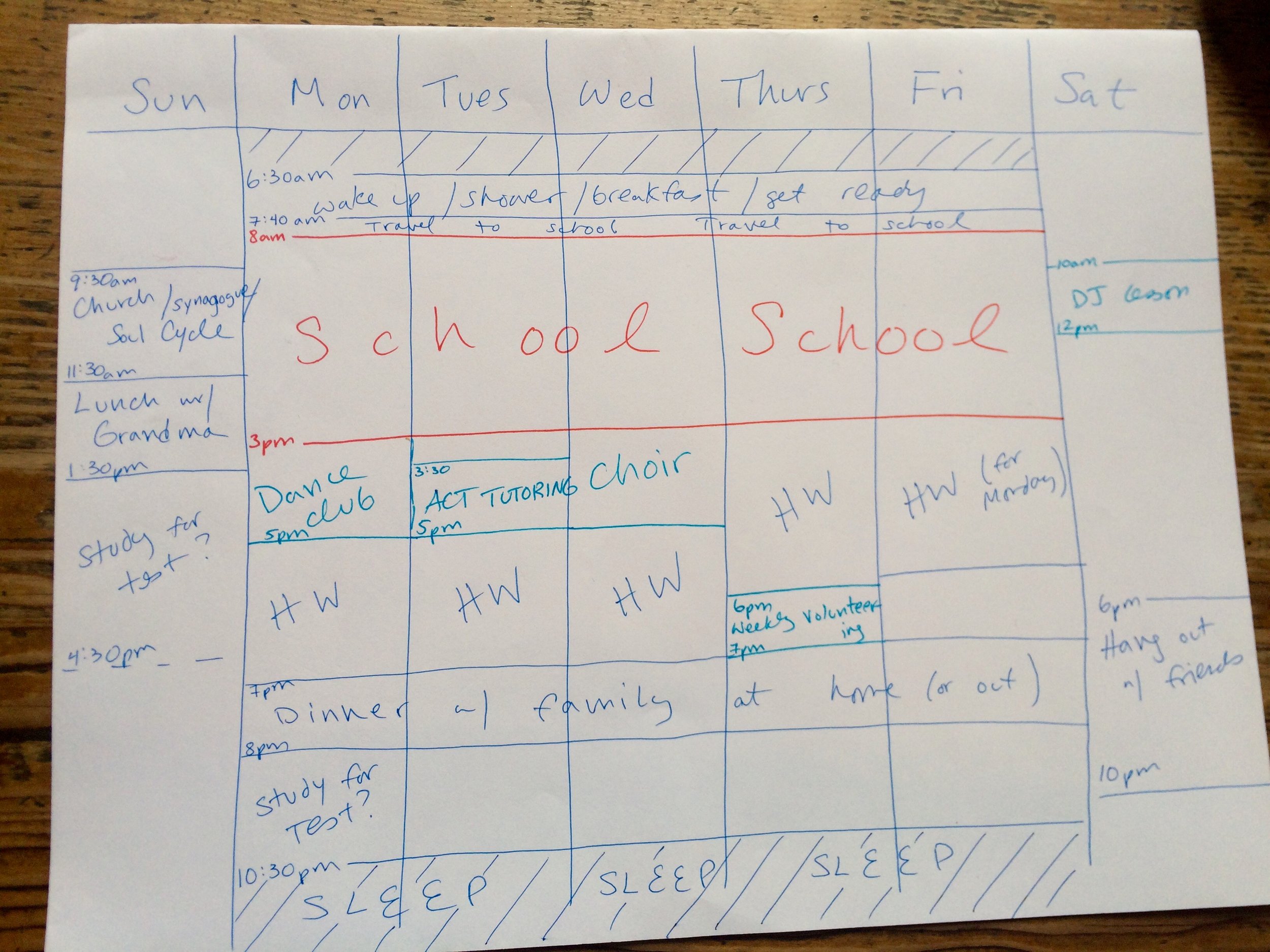
Now we've added in the blocks of time necessary to get homework done and blocked off time necessary to study for tests. Take a look at this schedule—it's a busy one, but it still has room to add a few compact blocks of ACT/SAT prep time. And taking social time into account and putting it on the schedule means that fun time can be guilt- and worry-free!
4) Take heart: this schedule is not forever!
When I have a ton of work or projects coming down the pike, I sometimes fret a bit about what that “means” for my future—like, if my schedule’s so tight that I have to plan when I’ll be taking my showers for a few weeks, that can look like it means I’m never going to have free time again, EVER.
Thankfully, this negative spin on things just isn’t true. There are specific periods of time when I have to make every minute count and don’t have as much time to chill, sure. But those periods of high intensity always come to an end.
It’s the same with junior and senior years, luckily. Studying for the SAT or ACT, writing college applications—there’s no denying that these things will take up a lot of your time. However, in the big-picture view of your high school career, you probably have three to four months at most during both junior and senior years of such high-level stress. Then the pressure eases up to a more sustainable level! So just decide that you’re going to give it your all now—because…
the high-grade stress eventually ends.
I promise. Plus, learning to wrangle a tricky schedule now enables you to go on to achieve even bigger and better things with your life—and isn’t that the whole point of the college process?
Conclusion
Go ahead, my frantic friend—grab that pen and paper now (or open up a week-long calendar template in Canva), if you haven’t already. I know you’ll feel better after getting your obligations out of your head and onto the page.
Or, if you’d like someone to guide you through this exercise—or to figure out what pieces of SAT or ACT content and strategy you, specifically, need to study in order to hit your target score—you can book a meeting with me here.